
By | ACB News Stock Market Editorial Team
Corporate Travel Management Limited (ASX: CTD) resumed trading on 3 September after an almost year-long suspension, and its shares fell sharply on the first day back.
CTD had last traded at A$16.07 before the suspension. On its return, the shares closed at A$2.32, down more than 85%, before easing further to around A$2.25 the following day.
The decline reduced CTD’s market capitalisation from several billion dollars at its former peak to only a few hundred million.
The Australian Broadcasting Corporation described the reaction as a “savage assessment” of CTD’s future earnings prospects.
The scale of the share-price decline was striking, but it told only part of the story.
CTD’s delayed FY25 accounts, FY26 results and latest annual report revealed a broader set of issues, including revenue-recognition errors in the UK business, customer billing irregularities, supplier refunds not properly passed back to customers, and weaknesses in contract management and financial-reporting controls.
In April 2026, CTD disclosed that KPMG UK’s forensic review had identified potential historical revenue reversals of up to £118 million. By the end of August, disclosed customer remediation and refunds had approached A$246 million.
These developments also renewed attention on Doug Tynan, now co-founder and Chief Investment Officer of Sydney-based GCQ Funds Management, who was closely involved in VGI Partners’ scrutiny of CTD years earlier.
The Australian Financial Review reported that Tynan closed his long-running CTD short position last week at around A$0.17 a share, describing the trade as a “generational short”.
What stands out is how early Tynan and VGI began scrutinising CTD — back in 2018, when the shares were still trading above A$27 and the company remained one of the ASX market’s most highly regarded growth stocks.
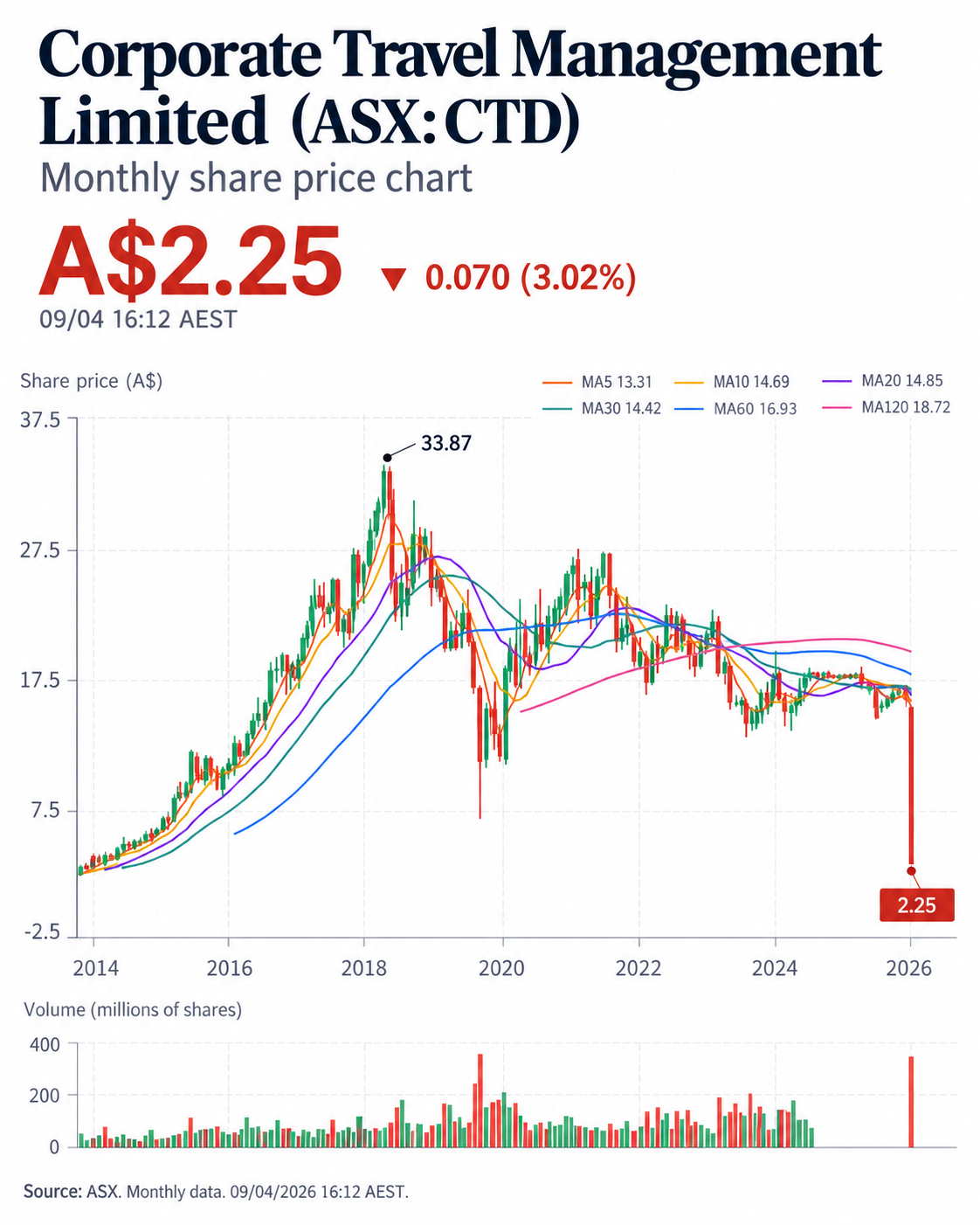
The Short Began When CTD Was Trading Above A$27
When VGI Partners began publicly raising concerns about CTD in October 2018, the shares were still trading above A$27.
At the time, VGI-managed portfolios collectively held short positions in more than 2 million CTD shares. Based on the A$27.64 market price immediately before the release of VGI’s report, the notional value of those positions was more than A$55 million.
VGI Partners Global Investments, then listed on the ASX as VG1, separately disclosed a short position of 609,906 CTD shares, equivalent to about 2.6% of its portfolio.
Reports at the time indicated that after CTD publicly rejected VGI’s claims and the share price suffered its first significant decline, VGI increased its aggregate short exposure by about 23%, taking the total position to more than 2.5 million shares.
A$27.64 was CTD’s quoted market price immediately before VGI’s report was released. It was not necessarily the fund’s average short-sale price, and no public disclosure appears to provide the precise average entry price across the portfolios involved.
CTD’s share price moved sharply over the following years, while Tynan continued to scrutinise the company’s reported financial performance. Just before the August 2025 suspension, the shares were still trading at A$16.07.
That contrast — a substantial short position disclosed when CTD was above A$27 and a reported exit near A$0.17 — helps explain why the trade has drawn so much attention.
The significance of the episode goes beyond the eventual return on the trade. Tynan had begun scrutinising CTD as early as 2018, years before the issues that later came to light.
At the time, CTD was one of the Australian market’s most closely followed growth companies. Since listing on the ASX in 2010, it expanded internationally through organic growth and a series of acquisitions, while reporting strong earnings growth.
On 28 October 2018, VGI distributed a 176-page research report to investors outlining around 20 areas of concern relating to CTD.
After requesting a trading halt, CTD responded on 31 October, acknowledging outdated office information and the incorrect use of the term “patented”, while rejecting VGI’s broader assertions.
VGI issued a further report in early November. CTD again rejected the claims and said it had asked EY to review several of the matters raised, including North American impairment testing, cash flow and working capital, and cash and interest income.
Among those closely involved in VGI’s work on CTD was Doug Tynan.
The Professional Foundations Behind Tynan’s Investment Approach
Tynan’s investment approach was shaped by a strong grounding in accounting and finance. He began his career as a chartered accountant in Brisbane after completing Commerce and Economics degrees at the University of Queensland, with majors in Finance and Accounting, and later became a CFA charterholder.
He joined VGI Partners in 2008 as a research analyst and rose to Head of Research soon afterwards. Over the following decade, he became closely involved in the firm’s investment work as VGI grew into a fund manager with more than A$3 billion under management.
After leaving his executive role at VGI in 2020, Tynan co-founded GCQ Funds Management the following year, where he now serves as Chief Investment Officer.
GCQ’s core strategy is focused not on short selling, but on identifying high-quality global businesses with durable competitive advantages, strong margins and returns on capital, conservative balance sheets and capable management teams.
That makes Tynan’s work on the short side particularly notable.
The same analytical discipline runs through both sides of the process: testing business quality, cash generation, balance-sheet strength and whether the financial statements support the underlying story.
Tynan has also spoken publicly about the role of checklists in investment analysis. In an interview republished by GCQ, he compared investment checklists with those used by airline pilots and emergency-room doctors, arguing that systematic processes can help reduce bias and improve decision-making.
That emphasis on financial statements, business quality, cash flow and disciplined review also featured in an earlier high-profile VGI short: Slater & Gordon.
Slater & Gordon: When the Numbers Told a Different Story — A Similar Analytical Lens
In 2015, Slater & Gordon was still one of the ASX market’s most prominent growth companies.
According to later media interviews republished by GCQ, Tynan and then-VGI analyst Justin Hardwick closely examined the law firm’s financial statements, focusing on whether the income statement, balance sheet and cash flow reconciled — and whether reported profits were supported by the underlying cash generation of the business.
That work led VGI to question the quality of Slater & Gordon’s reported earnings and circulate its research to investors.
Over time, concerns around accounting, asset values and cash generation became more visible, while the company’s UK expansion added pressure to the balance sheet. Slater & Gordon later recorded substantial impairments, underwent a major debt restructuring and saw its shares fall by more than 99% from their peak before being acquired by Allegro Funds and delisted in 2023.
The relevance to CTD lies in the analytical starting point: looking beyond headline profit to ask whether the numbers across the financial statements told the same story.
2018: A 176-Page Report That Put A Market Favourite Under The Microscope
CTD looked very different in 2018.
At the time, the company was expanding rapidly across several regions, completing acquisitions and reporting strong earnings growth.
VGI’s concerns went well beyond valuation. Its research questioned CTD’s unusually high margins, aspects of revenue recognition, the relationship between receivables and cash flow, the profitability of overseas operations, impairment assumptions and the scale of its international footprint. CTD rejected the broader conclusions and argued that VGI had misunderstood its financial performance and business model.
The issue that attracted the most media attention was the so-called “phantom offices” controversy. VGI’s team visited a number of CTD locations in Europe and North America and questioned whether some were consistent with the international footprint presented by the company.
CTD acknowledged that some office information on its website needed updating, but rejected suggestions that it had overstated the scale of its overseas operations. The company also argued that its corporate-travel model did not require large physical offices in every market.
With hindsight, the office issue was the most headline-friendly part of a much broader debate. The more consequential questions concerned the quality and consistency of CTD’s reported financial performance.
What Became Of VGI’s Concerns?
At the time, most of VGI’s specific financial concerns remained disputed. CTD rejected them in detail and engaged EY to review several of the matters raised. The company said EY’s preliminary observations supported its explanations on North American impairment testing, cash flow and working capital, and cash and interest income.
The developments of 2025 and 2026 therefore should not be read as a simple vindication of VGI’s 2018 thesis.
What is more striking is the overlap between some of the areas VGI chose to examine and the issues that surfaced years later.
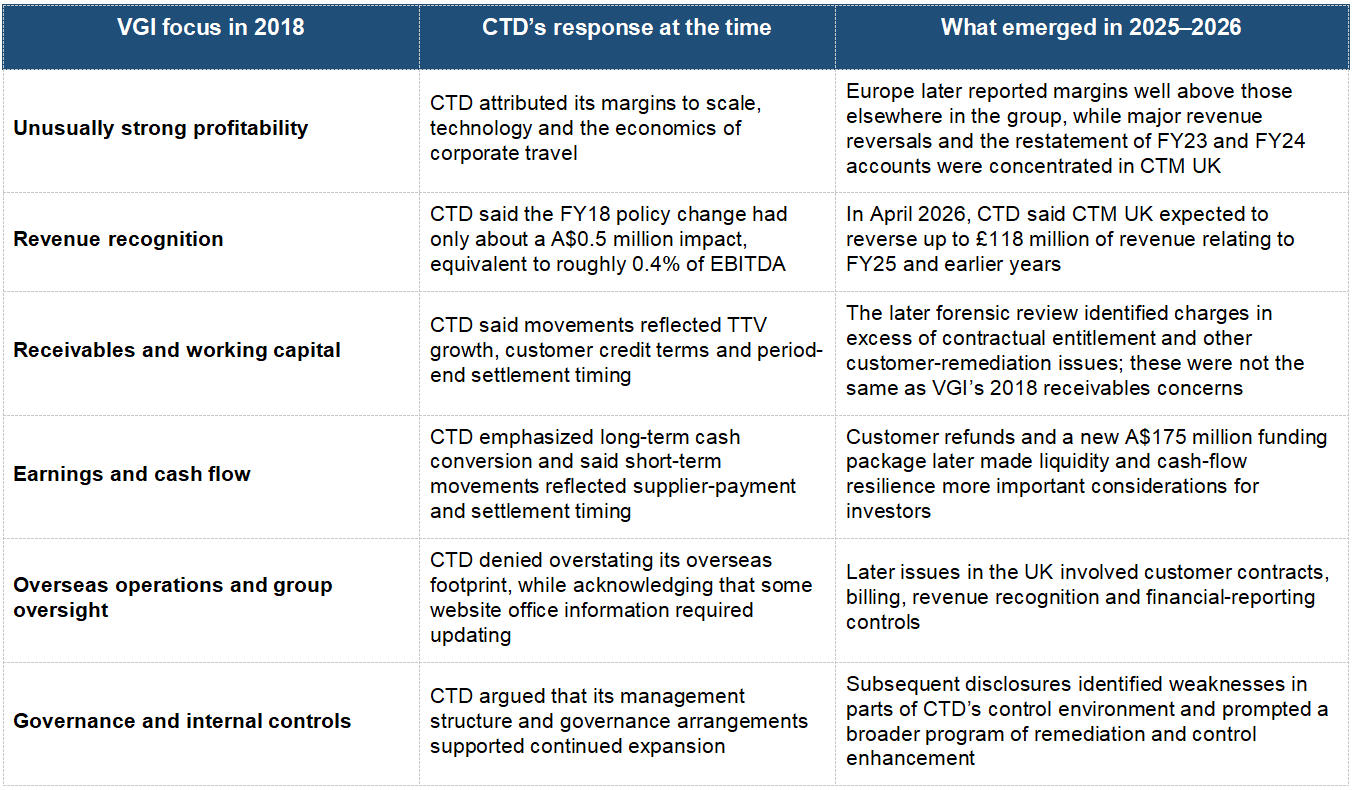
(Source: Compiled by Acbnews)
VGI’s 2018 report did not identify the specific UK customer-contract issues that emerged years later; many of those contracts did not yet exist at the time.
What stands out instead is the overlap in the areas under scrutiny — earnings quality, revenue recognition, cash conversion and overseas profitability. Europe became the clearest example.
For the half-year ended December 2023, CTD’s European business reported A$98.5 million in revenue and other income and A$63.0 million in underlying EBITDA, implying a margin of about 64%. Tynan later told ABC that CTD’s European margins had at one point exceeded those of Mastercard. His response was simple: “It just didn’t add up.”
The most significant issues CTD later disclosed were concentrated in Europe, particularly the UK. CTD’s April 2026 announcement said that by late 2022 the company had identified a £54.6 million difference between amounts charged to a major UK customer and amounts paid to hotels. KPMG’s later review identified concerns including charges in excess of contractual entitlement and the retention of client funds.
ABC later reported that UK-related issues had already been raised with CTD’s Audit and Risk Committee during the 2023 audit, and identified examples of duplicate billing and other customer-charging irregularities. CTD has said it found no evidence of intentional overbilling.
By late 2025, the matter had widened materially. Deloitte identified potential adjustments relating to Europe and CTM UK revenue, prompting the board to engage KPMG UK for a forensic review. CTD later confirmed material restatements for FY23 and FY24.
By April 2026, the company expected to reverse up to £118 million of historical revenue, with a further £10 million potentially relating to 1HFY26. By August, total disclosed customer remediation had approached A$246 million.
The scale of those disclosures helps explain the sharp market reassessment when CTD eventually returned to trading.
Beyond The Short Trade
The significance of Tynan’s CTD short goes beyond the reported A$0.17 exit.
What stands out is the discipline behind the analysis — continuing to test the quality of a business and its financial performance even when the share price was rising and market confidence remained strong.
Do reported earnings reconcile with cash flow and the balance sheet?
Are unusually high margins supported by a durable competitive advantage?
Does the business model justify the returns being reported?
Can the balance sheet and management systems support the pace of expansion?
These questions are consistent with the analytical discipline Tynan has carried into GCQ. The firm today focuses primarily on high-quality global businesses, beginning with industry structure and then testing competitive advantage, margins, returns on capital, financial leverage and management quality through a disciplined, checklist-based process.
Short selling may appear to sit at the opposite end of that philosophy. In analytical terms, however, the two can be viewed as mirror images of the same process.
When looking for a high-quality company, the task is to establish whether strong economics, cash generation, balance-sheet strength and management quality are durable. On the short side, the same framework can be turned around: are those qualities really as strong as they appear, and do the reported numbers support the market narrative?
That is what makes the Slater & Gordon and CTD episodes particularly revealing. In both cases, the starting point was not the share price itself, but whether the underlying business and the financial statements told a consistent story.
CTD’s Story Is Not Over
From VGI’s 176-page report in 2018 to forensic investigations, financial restatements and the 2026 sell-off, CTD has become an important case study in earnings quality and market confidence.
FY26 results show CTD remains a substantial global business: Revenue and Other Income rose 4% to A$669.9 million, Underlying EBITDA increased 36% to A$113.6 million, and NPAT returned to A$17.7 million.
But attention has shifted to the sustainability of those earnings, the cash-flow impact of remediation and the company’s financial position.
How long will it take CTD to rebuild market confidence?
The sharp fall after trading resumed reflected a broader reassessment of CTD’s financial outlook, risk profile and the confidence investors were willing to place in the company — not simply a change in near-term earnings expectations. The longer-term lesson is simple: when separate anomalies begin to point in the same direction, investors should keep asking questions.
延伸阅读:
澳股“矿进银退”?财报季后资源板块夺回主导 锂矿金矿股分红潮闸门洞开
【异动股】Corporate Travel Management(ASX:CTD)停牌逾一年后复盘惨跌85% 多收费丑闻持续啃噬市场信心
【异动股】Kaoko Metals (ASX:KAO) 纳米比亚Chalkos项目首钻两孔探触及强可见铜矿化 股价应声暴涨150%
【异动股】Cobre(ASX:CBE)增资1200万美元认购优先股 加快智利Sierra Atacama在产铜项目控股收购
【异动股】澳鹏Appen(ASX:APX)中报出炉股价大幅跳水 全球业务持续失血 中国市场担当增长引擎间加速收缩
国际合作不可或缺” 聚焦关键矿产推动共生协作 IMARC 2026凸显全球矿业治理转向
从资源贸易走向产业链协同——资本、技术与工程加速汇流 IMARC 2026呈现中澳矿业合作新图景
新井LF-08开钻在即!TMK Energy(ASX:TMK)Gurvantes XXXV项目试采井组迎重大升级 商业规模解吸产气验证冲刺最后一公里
【年报观察】Janus Electric(ASX: JNS)拐点之年:8个月股价暴涨900% 逾百辆换电订单印证技术实效 6千万澳元北美合同锚定增长预期
免责声明
本网站所载信息仅供一般参考之用,不构成任何投资、财务、法律或其他专业建议。尽管本网站力求信息准确与完整,但不对其准确性、完整性或时效性作出任何明示或暗示的保证。投资涉及风险,读者在作出任何投资决策前,应自行判断并咨询专业、独立的顾问。凡使用本网站内容者,即视为已阅读并接受本免责声明。
郑重声明(版权与转载说明)
ACB News《澳华财经在线》对标注为“原创”的文章依法享有完整著作权。
澳大利亚境内及境外任何媒体、机构、网站或应用程序,未经 ACB News 事先书面授权,不得以任何形式转载、摘编、改写或通过第三方平台传播相关内容。
凡未经授权而擅自转载或变相转载者,均构成侵权,ACB News 将依法追究其法律责任。
Copyright Notice
All articles labeled as “Original” on ACB News (澳华财经在线) are protected by copyright.
Any reproduction, republication, redistribution, or adaptation of such content, in whole or in part, in Australia or elsewhere, without prior written authorization from ACB News, is strictly prohibited and constitutes copyright infringement.