

【财经要闻】
内部文件揭示维州提出资助请求未获联邦政府回应 财政困境再引关注
维州与联邦政府在财政协作上的分歧正逐步显现。据维州反对党调取并提供给媒体的内部文件信息显示,2024年12月时任维州财政部长Tim Pallas通过部门简报,向联邦财长Chalmers提出一项未公开的资助请求。
维州财政部希望联邦政府依据依据联邦9亿澳元“国家生产力基金(NCP)”,为维州《经济增长声明》承担 50% 费用(约3.135亿澳元),并且计划在成功后2025年追加申请。然而,这份函件并未得到联邦方面的答复,维州至今未从该基金获得任何拨付,其他多个州/领地已累计分配超1亿澳元。
这一消息再度引发舆论对维州经济困境的密切关注。受监管流程繁琐、税负偏高及债务规模逼近2000亿澳元等因素影响,维州一度被评为全澳营商环境最弱的地区;近两年来,计入人口变化后其经济实际呈现收缩。
2024年末州政府推出投资6.27亿澳元的增长方案后,被评级机构指出,由于预算盈余被用于支出而非减债,财政修复周期可能拉长。
联邦层面并非毫无动作,总理阿尔巴尼斯于5月向维州郊区铁路环线追加38亿澳元资金,但否认其为变相纾困。
此外,由维州州长牵头设立的商业委员会自去年8月遭遇争执后全年停摆,从侧面反映出该州在治理沟通方面的挑战。
全球AI债务潮奔涌袭来 CDC Data Centres率先试水 澳洲首个投资级数据中心债券呼之欲出
全球AI资本开支超级周期正从股权与银行贷款向债务资本市场纵深推进。
摩根大通数据显示,今年全球AI及数据中心债券发行规模已突破三千亿美元;该行预估,至本十年末,仅美国数据中心投资总额将达5.5万亿美元,其中约四成来自投资级债务融资。
这一浪潮近期正式传导至澳大利亚:本土数据中心开发商CDC Data Centres启动路演,拟发行六年期及十年期高级担保固定利率票据,成为澳大利亚公开市场体系内首笔投资级数据中心债券。
CDC的先行得益于其相对同业更成熟的基建进度与本土聚焦。穆迪给予其Baa2稳定评级,肯定CDC的订单可见性、行业壁垒及股东背景。
(延伸阅读:《CDC与美国超大规模客户签署555兆瓦数据中心合同 盈利预计暴增3倍 Infratil(ASX: IFT)获提振股价飙至多年高点 》)
据主要股东披露,CDC Data Centres含债估值约为245亿澳元。穆迪预计其未来五年扩建计划还需投入170亿澳元。市场人士认为,这起债券发行的最终定价可能会重塑澳洲数据中心产业链从股权到银行债的全谱系成本基准。
市场并非毫无顾虑。部分投资者质疑AI终端付费能力与算力远期过剩风险,但数据中心无疑已成为本年全球债务扩张的核心驱动力。
(延伸阅读:《NEXTDC(ASX:NXT)锁定23亿澳元高级债务契约 总授信升至87亿 资本储备覆盖未来三年数据中心建设需求 》)
在澳洲,NextDC尚待运营数据以叩响投资级大门,AirTrunk则尝试架构重组后的资产证券化。CDC此番试水,既是本土资本适配全球科技周期的缩影,亦为观察债务工具如何承接实体算力基建提供重要切口。
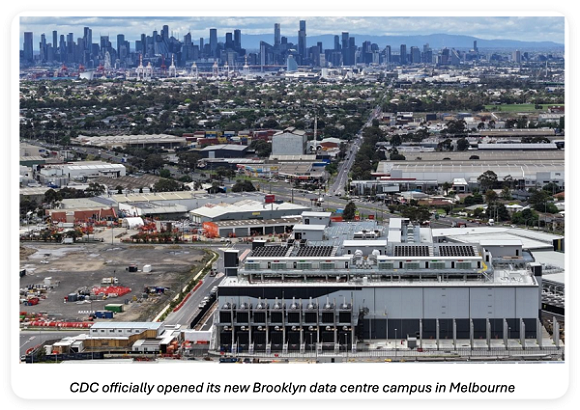
(图片来源:IFT公告)
【澳股】
采矿大亨Andrew Forrest斥资1.9亿澳元 借道收购Oaktree旧股入主澳洲钨矿商EQ Resources Limited(ASX:EQR) 押注西方供应链缺口与国防刚需
澳交所上市矿业公司EQ Resources Limited(ASX股票代码:EQR)周一披露,公司于7月17日上周五盘后获悉,由Andrew Forrest 博士全资持有的投资平台Wonongarra Pty Ltd同意收购Oaktree Capital 旗下基金持有的公司全部权益,包括862,131,779股全额缴足普通股及35,555,556份期权,约占EQR已发行资本的16.8%。
这笔总对价约1.9亿澳元的交易标志着Andrew Forrest自三年前与Nicola Forrest分居后,首次在共有投资载体Tattarang之外独立进行大额资源配置,市场预期Wonongarra后续将有更多交易落地。
EQR运营昆士兰Mt Carbine及西班牙Salamanca地区Barruecopardo两处钨矿,为中国境外最大钨生产商。受中国出口管制及美方要求防务承包商明年停采中国钨的叠加影响,Rotterdam国际钨价十二个月内涨超560%至逾3000美元/吨。
EQR管理层已推动两矿投产且运营状况稳定,在西方供应多处于研究阶段的背景下具先发优势。
财务方面,公司上年亏损近4000万澳元,然而营收即将放量增长。据市场共识预估FY26财年营收预计近1.7亿澳元,下财年随提产可能最高暴增至逾8亿澳元。
周一EQR股价升34%,市值突破15亿澳元。
EQR董事总经理Craig Bradshaw表示,Forrest博士的投资标志着股份所有权从财务投资者交由澳洲矿业资深人士接棒,是对公司的有力背书。
Forrest博士称,该投资旨在支持澳大利亚生产商及本地的就业和技术发展,看好EQR在全球供应链脆弱背景下持续去风险、提产及逐步创造实质性现金流的进展。
(更多详情阅读:《【异动股】钨矿结构性短缺快速凸显 EQ Resources (ASX:EQR)股价迎阶段性暴涨 年度上涨超五倍 》)
以9澳分每股入股、本次22澳分退出的Oaktree在两年多的持股中,见证EQ Resources对西班牙Barruecopardo钨矿的收购及昆士兰北部Mt Carbine钨矿的持续扩建,推动其成为最大的西方钨生产商。
Oaktree对钨市场走势的判断与Forrest存在差异,认为中期内不排除中外关系骤暖及中国钨供应回流导致的价格急剧回撤风险。
对此,有市场观察评论称,Forrest预计将会通过Wonongarra,借助个人关系网络为EQR开辟国际资源,尤其是欧洲市场;并且EQR属“已成型增长”而非初级勘探公司,即使钨价回归均值仍可盈利。
值得注意的是,与Forrest类似,澳洲另一重磅级富豪Gina Rinehart亦积极布局稀土资产,目前持有Arafura(ASX股票代码:ARU)、Lynas (ASX股票代码:LYC)等股,稀有金属投资估值近40亿澳元,约占其财富近10%。
澳华财经在线数据库显示,EQR最新价0.295澳元,已发行股本51.4亿股,市值15.2亿澳元。
【异动股】半导体IP技术公司Weebit Nano(ASX:WBT)上调FY26最低营收指引至1350万澳元 股价应声而落 年涨3.5倍之后回调整理
澳洲阻变存储器(ReRAM)IP开发商Weebit Nano Ltd (ASX股票代码:WBT) 宣布将截止6月30日的2026财年最低营收指引从1200万澳元上调至1350万澳元,为一年之内第二次上调。审计后的全年业绩将于8月28日正式公布。
随着技术商业化进程从研发验证转向技术转移(Technology Transfer),过去一年Weebit Nano股价自1.9澳元逐步放量上冲,在6月下旬达到8.89澳元高点,近期则出现显著回调,周一进一步回落7.36%。
现有闪存技术在功耗、微缩与耐温上存在局限,ReRAM作为闪存的替代者出现,被定位新一代非易失性存储器技术。
ReRAM的低延迟、非易失及存内计算特性,使其成为边缘AI、自动驾驶及数据中心推理加速的理想内存架构,受到半导体公司和代工厂关注。
官方资料显示,Weebit Nano拥有超过90项行业专利,是目前市场上唯一独立、已认证且可规模化的ReRAM IP供应商。
(延伸阅读:《【异动股】Weebit Nano (ASX:WBT)完成8000万澳元全额包销机构配售 巩固半导体存储技术行业领先地位》、《半导体存储技术公司Weebit Nano (ASX:WBT)与德州仪器达成许可协议 预估年营业额将突破千万澳元》 )
公司目前已与多家一线厂商签署商业授权,并获得韩国、以色列及欧盟政府的相关项目资金支持。
今年上半年WBT先后完成8000万澳元机构配售及1500万澳元股票购买计划,募集资金主要投入商业化规模扩大、AI产品开发生态与ReRAM技术进阶研发。
同赛道 IP 公司 eMemory、Alphawave的成长路径均为通过许可费深化客户绑定,继而迎来规模化版税(Royalties)拐点。
展望FY27 ,WBT能否跨越当前许可费阶段,实现首批实质性版税收入受到市场密切关注。
Maiden Resource Estimate Nears: Can Leo Grande Become Moonlight Resources’ First Post-Listing Valuation Anchor?
Moonlight Resources Ltd (ASX: ML8) — Company Observation
█ |By ACB News Stock Market Editorial Desk
Overview
The third quarter of 2026 is shaping up as Moonlight Resources’ first meaningful resource-pricing window since its ASX debut.
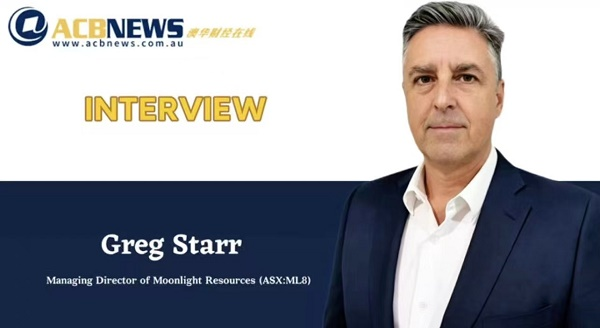
Managing Director Greg Starr told ACB News that the company is targeting completion of a maiden JORC Mineral Resource Estimate for Leo Grande by the end of September. Before then, Moonlight is advancing infill drilling, diamond drilling and metallurgical testwork — the technical workstreams needed to support the estimate.
Click here to watch the interview Video
For a junior explorer that raised A$10 million at its December 2025 IPO and carries a market value of about A$15 million, the investment case is beginning to shift. The question is no longer simply whether Leo Grande hosts gold, but how much gold can be converted into a formal resource — and what that could mean for Moonlight’s valuation.
Since listing, Leo Grande has moved from historical data review to more than 10,000 metres of systematic drilling. All 14 holes in the initial campaign intersected gold, while Phase 2 extended known mineralisation by 250 metres to the north-west and 200 metres to the south-east. As drilling continues to support the interpreted continuity between Leo Grande Central and South, the project is moving closer to becoming Moonlight’s first post-listing resource asset.
Terra Studio has also begun to frame the broader Clermont Gold Project in valuation terms. Its June report outlined a conceptual resource scenario of 402,600 ounces and, using peer-based metrics, estimated a potential enterprise value of about A$44 million for Moonlight Resources.
With the maiden MRE approaching, investor attention is shifting from exploration potential to resource scale, classification and valuation. Leo Grande’s ability to turn drilling momentum into a defined resource will be Moonlight’s most important post-listing value test.
Beyond the IPO Story: What Did Investors Really Buy?
Moonlight Resources listed in December 2025 after raising A$10 million at A$0.20 a share. At the time of writing, the stock was trading around A$0.16, implying a market capitalisation of roughly A$15 million.
The IPO offered exposure to a portfolio spanning gold, rare earths and uranium across more than 5,200 square kilometres. But from the outset, the Clermont Gold Project in central Queensland stood apart as the company’s priority asset, with Leo Grande emerging as the most advanced opportunity for near-term resource definition.
Leo Grande was not a blank-sheet target. Exploration dating back to the 1990s left behind 4,620 metres of historical drilling, including about 70 shallow reverse-circulation holes and evidence of a mineralised trend extending for roughly four kilometres.
The gold was evident. The scale was not.
The unresolved question was whether those historical intersections represented isolated zones or fragments of one larger, continuous shear-hosted system capable of supporting a maiden resource.
That uncertainty defined the IPO proposition. Moonlight came to market with credible targets and considerable geological upside, but without a quantified resource base against which investors could assess scale. ML8 was therefore priced as an early-stage explorer — attractive for its potential, but still lacking a resource anchor.
Since listing, Starr and his team have concentrated exploration at Leo Grande. The strategy has been direct: validate the historical database, close the gaps between existing holes, test continuity and build a geological model robust enough for resource estimation.
The significance of the new drilling is not simply that it keeps finding gold. It is that each result is tightening the geological picture. Leo Grande is beginning to look less like a collection of historical intercepts and more like a shallow, coherent and potentially scalable gold system.
For Moonlight, that is the inflection point: the moment geological promise begins to turn into something the market can measure, compare and price.
Reassessing Leo Grande: A Head Start on Resource Definition
Many newly listed explorers begin with little more than a geological thesis and the hope that drilling will turn theory into evidence.
Leo Grande starts further down that road — with a substantial historical database, broad near-surface mineralisation and the advantage of being located within an established mining region.
The Clermont Gold Project lies about 15 kilometres west of the town of Clermont in central Queensland, within reach of road, rail, power and water infrastructure. Across the broader region, projects such as Pajingo, Wirralie, Mount Carlton and Ravenswood reflect a long history of gold discovery, mine development and mining services.
The more immediate regional reference is GBM Resources’ Twin Hills Gold Project, about 120 kilometres away by road.
Twin Hills hosts a JORC Mineral Resource of 23.11 million tonnes at 1.3 g/t gold and 6.5 g/t silver, containing about 999,200 ounces of gold and 4.82 million ounces of silver. Roughly 60% of the resource is classified in the Measured and Indicated categories.
Twin Hills does not predict the outcome at Clermont. But it does provide a useful point of reference: central Queensland has already shown that gold systems of meaningful scale can be defined, advanced and placed on a credible development pathway.
Leo Grande itself is also far from a blank canvas. Historical exploration delivered about 70 shallow RC holes for a total of 4,620 metres and traced a mineralised trend extending for roughly four kilometres.
46m at 1.01 g/t Au from 6m
29m at 1.17 g/t Au from surface
22m at 2.25 g/t Au from 40m
19m at 3.35 g/t Au from 34m
25m at 1.87 g/t Au from 26m
The historical drilling revealed broad, near-surface mineralisation controlled by a regional shear structure. Most holes were shallower than 140 metres, yet several remained mineralised at depth — leaving the system open both along strike and down dip.
That geometry is more than a geological detail. It is central to the project’s development appeal.
Terra Studio has argued that Leo Grande’s shallow position and oxide characteristics could support a lower-cost open-pit concept and a competitive processing route.
Those assumptions still need to be tested through metallurgy and formal studies, but the foundations are favourable: shallow mineralisation, accessible infrastructure and a mature regional mining ecosystem.
The historical database gave Moonlight a valuable head start. Its weakness was not a lack of gold, but the distance between the drill holes.
Wide spacing left too many gaps to establish continuity or support a formal resource estimate. Moonlight’s post-listing strategy has therefore been clear: tighten the drill grid, connect the mineralised zones and turn decades of geological evidence into a maiden JORC resource.
That is the real promise of Leo Grande — not simply that gold has been found before, but that the project may now be approaching the point where its scale can finally be defined.
From a 100% Hit Rate to 450 Metres of Extension
Moonlight completed its first post-listing RC campaign in December 2025 and reported the results the following month. All 14 holes, covering 940 metres, intersected gold mineralisation.
Key results included 40 metres at 1.30 g/t gold from surface in LGRC067; 34 metres at 1.37 g/t from six metres in LGRC062, including 10 metres at 2.52 g/t; 24 metres at 1.28 g/t from two metres in LGRC060; and 21 metres at 1.28 g/t from 19 metres in LGRC065.
LGRC067, LGRC062 and LGRC065 all ended in mineralisation, indicating that the system remained open in those directions.
If the first campaign validated the historical picture, Phase 2 — launched in February 2026 — was designed to test how far the system might extend.
Results released on May 7 showed 42 metres at 1.01 g/t from surface in LGRC102 and 40 metres at 1.31 g/t from 76 metres in LGRC105, including five metres at 3.40 g/t, on the south-eastern extension. To the north-west, LGRC092 returned 18 metres at 1.55 g/t from 60 metres, including three metres at 7.80 g/t.
The programme extended known mineralisation by 250 metres to the north-west and 200 metres to the south-east. It also strengthened Moonlight’s interpretation that the Leo Grande Central mineralised zone may continue along the shear towards Leo Grande South, where historical drilling had already identified mineralisation.
In June, Moonlight reported assays from a further 22 RC holes covering 2,683 metres. Results included 20 metres at 1.00 g/t from 82 metres in LGRC101; 22 metres at 0.95 g/t from 100 metres in LGRC125, including nine metres at 1.41 g/t; 15 metres at 1.08 g/t from 100 metres in LGRC120; and 14 metres at 1.11 g/t from 115 metres in LGRC122, including four metres at 2.22 g/t.
The latest results continued to test the south-eastern extension of Leo Grande Central and added density to the drill grid. Moonlight said mineralised thickness and grade were showing encouraging continuity across multiple sections, while several deeper holes ended in mineralisation.
By June, the expanded Phase 2 programme had reached about 10,000 metres, with further assays still pending. The growing dataset is doing more than adding metres: it is narrowing the uncertainty around the geometry, continuity and scale of the system.
Starr captured the point in an interview with ACB News: “This is a growing system where individual results are less important than the collective results.”
The Inflection Point: From Discovery to Resource Definition
Leo Grande is now moving beyond historical validation and into the technical work required for a maiden resource estimate.
The market’s focus is shifting with it — from whether the project contains gold to how much of that gold can be classified, quantified and ultimately valued.
Moonlight’s June update said Phase 2 drilling was testing continuity between Leo Grande Central and South, extending the system along strike and at depth, and increasing drill density to support a future MRE.
Starr told ACB News that the company is targeting completion of the maiden MRE by the end of September 2026.
To get there, Moonlight is advancing three parallel workstreams: tighter-spaced drilling, diamond drilling and metallurgical testwork. Samples have already been sent to the laboratory, with the results expected to inform the project’s processing assumptions.
The company is also planning to begin a conceptual mining project study alongside the MRE. The aim is to test what a future development could look like at the scale currently being defined — including potential mining configuration and commercialisation options.
That matters because Moonlight is not treating the MRE as the end of exploration. It is positioning the estimate as the bridge between geology and development.
Terra Studio’s June report reached a similar conclusion, forecasting a maiden MRE in the third quarter and a possible resource update in the fourth quarter, followed by scoping work.
If that timetable holds, the third quarter will mark Moonlight’s first formal resource-pricing event.
The next phase — metallurgy, resource expansion and early study work — could begin to move the market from valuing ounces in the ground to considering how those ounces might one day be developed.
Valuation Frameworks Begin to Take Shape
As Leo Grande moves through historical data validation, strike extension and tighter drilling, the market is beginning to look beyond geology and towards valuation.
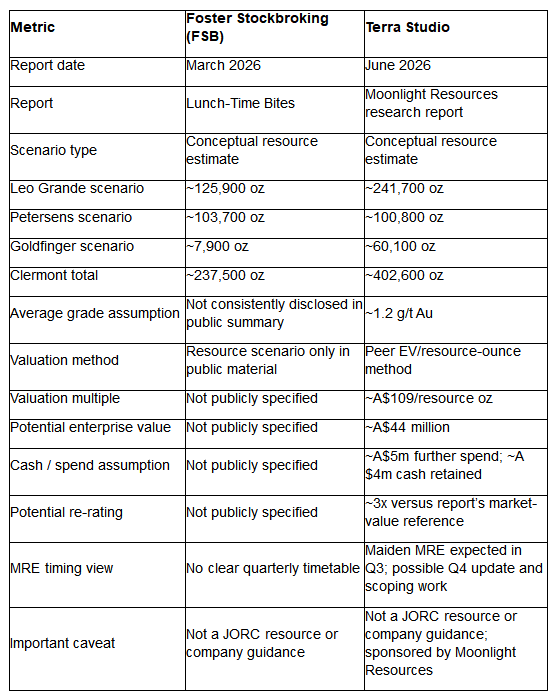
Two publicly available studies now provide the clearest reference points: Foster Stockbroking’s March Lunch-Time Bites note and Terra Studio’s June research report.
FSB was the first to suggest that Clermont could support a conceptual gold inventory of more than 200,000 ounces. Its model estimated 237,500 ounces across three targets — about 125,900 ounces at Leo Grande, 103,700 ounces at Petersens and 7,900 ounces at Goldfinger.
Terra Studio later revisited the project using the latest drilling results and arrived at a more ambitious scenario.
It estimated 241,700 conceptual ounces across Leo Grande North, Central and South. Adding about 100,800 ounces at Petersens and 60,100 ounces at Goldfinger lifted the broader Clermont scenario to approximately 402,600 ounces at an average grade of about 1.2 g/t gold.
Terra Studio then applied a peer-derived valuation multiple of roughly A$109 per resource ounce. On that basis, it estimated a potential enterprise value of about A$44 million for Moonlight Resources under the 402,600-ounce scenario.
The report also assumed Moonlight could spend about A$5 million on further exploration and retain roughly A$4 million in cash. Against the market value used in its analysis, Terra Studio concluded that the company offered about three times potential re-rating upside.
These figures are not JORC resources and they are not company guidance. They are third-party conceptual models. Terra Studio also disclosed that its report was sponsored by Moonlight Resources. That does not remove the model’s usefulness, but it makes the maiden MRE the decisive test.
The significance of the two studies is not that they settle the valuation debate. It is that they begin to frame it.
FSB placed Clermont at about 237,500 ounces. Terra Studio lifted the conceptual case to about 402,600 ounces. The market is now waiting to see where the first formal resource estimate lands between expectation and evidence.
Clermont Gold Project: Third-Party Resource and Valuation Scenarios
Conclusion: A Defining Quarter for Moonlight
Moonlight’s most important shift since listing is not any single drill result. It is the gradual conversion of Leo Grande from a collection of historical mineralised intersections into a potentially measurable and priceable resource asset.
From a 4,620-metre legacy database to more than 10,000 metres of modern drilling, the company has built a clearer picture of a shallow system extending along the Leo Grande shear.
Third-party research has begun to attach numbers to that potential. The maiden MRE will now decide how much of the story survives formal resource estimation.
With further assays, metallurgical results and diamond drilling progressing ahead of the September target, the third quarter is set to become Moonlight’s most important value-verification period since listing.
For Leo Grande, the next milestone is no longer another promising intercept. It is a resource the market can finally measure.
Disclaimer: This article is for information only and does not constitute investment advice. Early-stage mineral exploration companies carry significant geological, technical, funding and market risks. Investors should refer to Moonlight Resources’ official ASX announcements and JORC-compliant disclosures before making any investment decision.
全球市场:美股三大指数小幅收跌 大型科技股涨跌不一 热门中概股多数上涨
美股市场:美股三大指数07月20日收盘全线下跌。截至收盘,道琼斯工业平均指数比前一交易日下跌307.16点,收于51839.26点,跌幅为0.59%;标准普尔500种股票指数下跌14.41点,收于7443.28点,跌幅为0.19%;纳斯达克综合指数下跌12.17点,收于25508.07点,跌幅为0.05%。
欧股市场:欧洲三大股指07月20日涨跌不一。英国伦敦股市《金融时报》100种股票平均价格指数报收于10524.76点,较前一交易日下跌75.61点,跌幅为0.71%;法国巴黎股市CAC40指数报收于8340.11点,较前一交易日上涨1.3点,涨幅为0.02%;德国法兰克福股市DAX指数报收于24846.69点,较前一交易日上涨15.71点,涨幅为0.06%。
隔夜要闻
美国宣布对加拿大部分产品加征50%关税
当地时间7月20日,白宫发布公告称,美国将对加拿大部分产品额外加征50%的从价关税,以应对“加拿大在汽车及汽车零部件贸易方面对美国采取的歧视性措施”。据称,新关税将自美东时间8月19日凌晨00时01分起生效,并将在现有相关关税、税费及其他收费基础上叠加征收。
“七巨头”时代终结?分析师:这一概念已不再适用 AI投资逻辑正在重构
花旗集团策略师表示,在判断如何参与美国人工智能(AI)投资交易时,广为流传的“科技七巨头”(Magnificent Seven)概念已经“不再适用”。所谓“七巨头”,是指英伟达、苹果、谷歌母公司Alphabet、微软、亚马逊、Meta以及特斯拉。
美股回调背后暗藏激烈博弈:空头押注水平创纪录
最新统计显示,美股市场的做空押注已飙升至有统计以来的高位,这或许是近期科技牛股纷纷回调的部分原因。据S3 Partners自2010年以来收集的数据,标普500成分股的空头仓位占自由流通股比例目前正在逼近3.79%,距历史最高水平仅一步之遥。与此同时,罗素3000指数成分股的空头比例近期升至6.3%,已经创下纪录。
全球主要股市半导体股为何集体下跌
受半导体股为主的科技股强劲走势的支撑,全球主要股票市场以上涨结束上半年行情。不过,近几周,科技股出现调整,引发美欧日韩等主要股市相继出现下调,而半导体股成为主要的下跌板块。本轮抛售潮由韩国股市率先引爆,短短三周时间快速传导至美国、欧洲市场,日本股市也开始下跌,近乎形成全球性同步杀跌。其中,半导体、AI算力、存储等股票成为重灾区。
贝莱德拟发逾120亿美元债券 为Meta得州数据中心提供融资
最新消息显示,贝莱德正计划发行超过120亿美元债券,为Meta位于美国得州埃尔帕索的数据中心园区提供融资。这是近期一系列为科技公司大规模人工智能(AI)投资提供资金支持的债务融资交易中的最新一笔。
空中出租车公司变身军工玩家 美eVTOL企业开辟防务市场股价暴涨
周一(7月20日),Archer Aviation在官网宣布,公司与防务科技公司Anduril发布垂直起降飞行器(VTOL)平台。该平台的研发基于双方于2024年达成的合作协议,可同时应用于商业和军事领域。
谷歌被曝正打造新型AI服务器芯片 目标大幅提升Gemini运行效率
最新消息显示,谷歌正在研发一款内部代号为“Frozen v2”的新型服务器芯片,旨在更高效地运行Gemini模型。据报道,这款芯片将把Gemini模型部分架构永久嵌入到芯片之中,从而减少回答用户问题所需的计算量和数据传输量。
英国AI新材料初创公司CuspAI获4.5亿美元融资 贝索斯基金、英国政府参投
当地时间周一,英国人工智能新材料初创公司CuspAI宣布,公司已完成4.5亿美元融资,投资方包括英国政府以及亚马逊创始人杰夫·贝索斯旗下投资基金。该公司正致力于利用AI发现全新材料,以推动芯片等关键产业的发展。
从厄尔尼诺到欧洲热浪!大宗商品策略师警告:市场低估了极端天气的影响
多位大宗商品策略师近日警告称,随着极端热浪席卷欧洲、气象学家警示今年可能出现强厄尔尼诺现象,市场正在低估气候波动对各类资产的影响,而全球大宗商品市场也面临着新的不确定性。世界气象组织(WMO)预计,今年7月至9月期间,热带太平洋地区可能出现一次“强厄尔尼诺事件”。厄尔尼诺是一种自然形成的气候现象,会导致特定海域海面温度升高,通常与极端天气密切相关。
免责声明:本文基于AI生产,仅供参考,不构成任何投资建议,据此操作风险自担。东方财富发布此内容旨在传播更多信息,与本平台立场无关。东方财富力求但不保证数据的完全准确,如有错漏请以中国证监会指定上市公司信息披露媒体为准,东方财富不对因该资料全部或部分内容而引致的盈亏承担任何责任。用户个人对服务的使用承担风险,东方财富对此不作任何类型的担保。
文章来源:东方财富Choice数据
( 部分资料来源:澳洲金融评论 澳大利亚人报 RBA)
免责声明
本网站所载信息仅供一般参考之用,不构成任何投资、财务、法律或其他专业建议。尽管本网站力求信息准确与完整,但不对其准确性、完整性或时效性作出任何明示或暗示的保证。投资涉及风险,读者在作出任何投资决策前,应自行判断并咨询专业、独立的顾问。凡使用本网站内容者,即视为已阅读并接受本免责声明。
郑重声明(版权与转载说明)
ACB News《澳华财经在线》对标注为“原创”的文章依法享有完整著作权。
澳大利亚境内及境外任何媒体、机构、网站或应用程序,未经 ACB News 事先书面授权,不得以任何形式转载、摘编、改写或通过第三方平台传播相关内容。
凡未经授权而擅自转载或变相转载者,均构成侵权,ACB News 将依法追究其法律责任。
Copyright Notice
All articles labeled as “Original” on ACB News (澳华财经在线) are protected by copyright.
Any reproduction, republication, redistribution, or adaptation of such content, in whole or in part, in Australia or elsewhere, without prior written authorization from ACB News, is strictly prohibited and constitutes copyright infringement.











![[更新]【10.6】今日财经时讯及重要市场资讯](https://xghaiwai.oss-cn-hongkong.aliyuncs.com/uploadfile/2026/0830/1788104410165198.png)